TLDR
Both Q-switched and pico lasers can remove tattoos effectively — but the right choice depends on the specific technology, the operator's skill, and your individual tattoo. The marketing around pico lasers has significantly outpaced the clinical evidence. At NuBare, we use the Quanta Q Plus C EVO after extensive research, and the results speak for themselves.
Table of Contents
- How Laser Tattoo Removal Works
- What Is a Q-Switched Laser?
- What Is a Pico Laser?
- Quanta Q Plus C EVO vs Pico: Head-to-Head Comparison
- Why the Pico Hype Doesn't Tell the Full Story
- Why NuBare Chose the Quanta Q Plus C EVO
- Frequently Asked Questions
How Laser Tattoo Removal Works {#how-it-works}
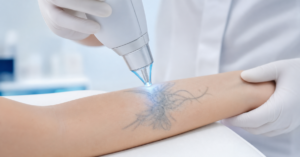
All laser tattoo removal works on the same principle: concentrated pulses of light energy penetrate the skin and are absorbed by tattoo ink particles. The energy causes the ink to shatter into tiny fragments, which your immune system then flushes away naturally over the following weeks.
The key variables between different lasers are:
- Pulse duration — how long each burst of energy lasts
- Wavelength — which ink colours the laser can target
- Peak power — how much energy is delivered per pulse
- Mechanism of action — whether the ink breaks down through heat, pressure, or sound waves
These variables determine how effectively a laser removes different ink colours, how many sessions you need, and how much risk of side effects exists.
What Is a Q-Switched Laser? {#q-switched}
A Q-switched laser fires pulses in the nanosecond range — that's billionths of a second. This rapid delivery of energy creates what's known as a photoacoustic effect: the ink particles absorb the energy and explode into tiny fragments through a combination of heat and sound waves.
Q-switched lasers typically operate at multiple wavelengths:
- 1064nm — highly effective on black and dark blue inks
- 532nm — targets red, orange, and yellow inks
- 694nm (Ruby) — effective on green, teal, and stubborn blue-green inks
The Quanta Q Plus C EVO is one of the most advanced Q-switched systems available, combining all three wavelengths in a single platform. This gives it the ability to target virtually every ink colour with clinical precision.
What Is a Pico Laser? {#pico}
A pico laser fires pulses in the picosecond range — trillionths of a second, roughly 100 times faster than a Q-switched pulse. The theory is that this ultra-fast delivery creates a stronger pressure wave (photomechanical effect) that shatters ink particles into even smaller fragments, potentially requiring fewer sessions.
Pico lasers are often marketed as the "next generation" of tattoo removal technology. Brands like PicoSure, PicoWay, and Enlighten are widely advertised in the industry.
However, the marketing narrative around pico lasers is considerably more polished than the clinical evidence supporting their superiority over high-quality Q-switched systems.
Quanta Q Plus C EVO vs Pico: Head-to-Head Comparison {#comparison}
| Feature | Quanta Q Plus C EVO | Pico Laser (e.g. PicoSure) |
|---|---|---|
| Pulse duration | Nanoseconds | Picoseconds |
| Wavelengths | 1064nm, 532nm, 694nm Ruby | Typically 755nm (PicoSure), some multi-wavelength |
| Ink colours targeted | All colours including difficult greens and reds | Strong on blue/green; limited on red/orange (PicoSure) |
| Mechanism | Photoacoustic (heat + sound) | Photomechanical (pressure) |
| Clinical evidence base | Extensive, well-documented | Growing, but marketing claims often ahead of evidence |
| Cost per session | Generally more affordable | Often higher due to equipment cost |
| Risk profile | Low in experienced hands | Low in experienced hands |
| Operator dependency | High | High |
One important note: PicoSure's primary wavelength is 755nm, which targets blue and green inks well but has limited effectiveness on red and orange inks — colours that the Quanta's 532nm wavelength handles easily. If your tattoo contains warm colours, this is a significant consideration.
Why the Pico Hype Doesn't Tell the Full Story {#hype}
The pico laser marketing machine is impressive. Clinics that use pico technology invest heavily in advertising it as superior — and because it's a newer (and more expensive) technology, the "newer equals better" assumption is easy for consumers to make.
But the clinical reality is more nuanced:
1. The operator matters more than the machine
A high-quality Q-switched laser operated by a skilled, qualified clinician will consistently outperform a pico laser in the hands of an under-trained technician. The machine is only part of the equation.
2. Pico lasers have a narrower wavelength range in many models
PicoSure, one of the most heavily marketed pico systems, operates primarily at 755nm. This is effective for certain ink colours but doesn't match the full-spectrum coverage of a multi-wavelength system like the Quanta Q Plus C EVO.
3. Marketing claims have faced legal scrutiny
PicoSure's manufacturer Cynosure faced a class action lawsuit in the United States for allegedly overstating their technology's effectiveness in tattoo removal. A similar legal challenge was also filed in Australia. When a technology's marketing has attracted litigation for false claims, it warrants healthy scepticism. (Source: Truth in Advertising)
4. Results depend on many factors beyond laser type
Ink colour, depth, density, age, skin type, and spacing between sessions all affect outcomes. The best results come from a clinician who understands all of these variables — not just one who has the newest equipment.
Why NuBare Chose the Quanta Q Plus C EVO {#why-quanta}
When Melanie was researching laser technology for NuBare, she approached it the same way she approaches everything — as a scientist. That meant ignoring the marketing and looking at results-based documentation: real before-and-after outcomes, peer-reviewed evidence, and clinical track records.
The Quanta Q Plus C EVO stood out for several reasons:
Three wavelengths in one system
With 1064nm, 532nm, and 694nm Ruby, the Quanta can address every ink colour in a single platform. Black, dark blue, red, orange, yellow, green — all within reach, without needing multiple machines or referring clients elsewhere.
Proven track record
The Quanta system has an extensive clinical history with documented outcomes across thousands of cases. It's used in medical and dermatological settings worldwide and manufactured by Quanta System in Milan, Italy — a company with a decades-long reputation in medical laser technology.
Photoacoustic precision
The nanosecond pulse delivery creates a controlled photoacoustic effect that breaks ink down effectively while preserving surrounding skin tissue. In the hands of a qualified operator, it delivers consistent results with a low side effect profile.
Scar-free results
The combination of the right technology and Melanie's scientific training has produced thousands of scar-free results at NuBare. That track record is what matters most.
Frequently Asked Questions {#faq}
Is pico laser better than Q-switched for tattoo removal?
Not categorically. Pico lasers have advantages for certain ink colours and skin types, but high-quality Q-switched systems like the Quanta Q Plus C EVO match or exceed pico performance across a wider range of tattoos — particularly multi-coloured ones. The operator's skill and clinical approach remain the most important factors regardless of which technology is used.
Can the Quanta Q Plus C EVO remove coloured tattoos?
Yes. The Quanta Q Plus C EVO has three wavelengths (1064nm, 532nm, 694nm Ruby) that collectively target all common ink colours, including notoriously difficult greens, teals, and reds. Many pico systems with a single wavelength struggle with these colours.
Does pico laser hurt less than Q-switched?
Some clients report slightly less discomfort with pico lasers due to the different energy delivery mechanism. However, at NuBare we use cold air cooling throughout every session, which significantly reduces discomfort regardless of laser type.
How many sessions will I need with the Quanta Q Plus C EVO?
Most clients need 5–10 sessions spaced 6–8 weeks apart. The exact number depends on your tattoo's size, colour, ink density, age, and your skin type. Melanie provides a personalised estimate during every free consultation.
Why do so many clinics use pico lasers if they're not necessarily better?
Partly because pico lasers are newer, which creates a marketing advantage. Partly because some pico systems do perform very well in specific use cases. And partly because the higher equipment cost for clinics means higher session fees — which makes them commercially attractive to position as premium. The best approach is to look at before-and-after results, not marketing materials.
See the Results for Yourself
At NuBare Laser Clinic, we believe the proof is in the results — not the brochure. Browse our before-and-after gallery on Instagram @nubare_tattooremoval to see real outcomes from real clients treated with the Quanta Q Plus C EVO.
Melanie is a qualified Medical Scientist (BSc, skin physiology and immunology) with 9+ years of laser tattoo removal experience on the Gold Coast. Every treatment at NuBare is calibrated with clinical precision — not guesswork.
Book your free consultation — Melanie will assess your tattoo, explain the technology, and give you an honest, personalised treatment plan with no obligation.
Curious about cost? See our Gold Coast tattoo removal pricing guide or learn more about our Gold Coast clinic.