TLDR
Yes, laser tattoo removal hurts — but for most people it's very manageable and far less painful than they expect. The sensation is most commonly described as a rubber band snapping against the skin, or hot bacon fat spitting onto your arm. Sessions are short (often just minutes), and techniques like cold air cooling and topical anaesthetic cream can reduce discomfort significantly. If you could handle getting the tattoo, you can handle getting it removed.
Table of Contents
- What Does Laser Tattoo Removal Feel Like?
- Is Tattoo Removal More Painful Than Getting a Tattoo?
- Pain by Body Location
- What Affects How Much It Hurts?
- How to Minimise the Pain
- What Happens to Your Skin After a Session?
- Side Effects to Know About
- Frequently Asked Questions
What Does Laser Tattoo Removal Feel Like? {#what-does-it-feel-like}
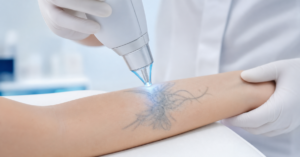
The most common description from clients is a rubber band snapping against the skin — a sharp, quick sting that fades immediately. Others describe it as similar to hot bacon fat spitting onto your arm, or a repeated flicking sensation.
Each laser pulse lasts a fraction of a second, so the discomfort is brief rather than continuous. Unlike getting a tattoo — where the needle works over a prolonged period — laser sessions are fast. A small tattoo might take just 2–3 minutes. Even a medium-sized piece typically takes under 10 minutes.
The overall experience for most clients is: surprising, quick, and entirely manageable.
At NuBare Laser Clinic, we use cold air cooling (Koolio machine) throughout every session, blowing air at around -30°C onto the skin before, during, and after treatment. This significantly reduces both the pain and the risk of thermal injury.
Is Tattoo Removal More Painful Than Getting a Tattoo? {#more-painful-than-getting}
For most people, no.
Getting a tattoo involves a needle repeatedly puncturing the skin over an extended period — which for larger pieces can mean hours of sustained discomfort. Laser tattoo removal sessions are far shorter, and the discomfort is more intense but brief rather than prolonged.
The general consensus from clients who have done both: laser removal is sharper but quicker. Most people find it less daunting than they anticipated.
A useful benchmark: if you were able to sit through getting the tattoo, you can sit through getting it removed.
Pain by Body Location {#pain-by-location}
Just like getting a tattoo, removal hurts more in some areas than others. Areas with thinner skin, less fat, and proximity to bone tend to be more sensitive.
| Body Area | Pain Level |
|---|---|
| Outer arm / shoulder | Low |
| Upper back / shoulder blade | Low to moderate |
| Thigh / calf | Low to moderate |
| Chest | Moderate |
| Ribs / side | Moderate to high |
| Inner arm / wrist | Moderate to high |
| Spine / lower back | Moderate to high |
| Ankle / foot | High |
| Neck / behind ear | High |
| Fingers / hands | High |
Areas with more muscle and fat (like the outer arm or thigh) tend to be much more comfortable. Bony areas, joints, and spots with thin overlying skin are the most sensitive.
What Affects How Much It Hurts? {#what-affects-pain}
Ink density
Heavily saturated tattoos with dense, concentrated ink create a stronger photoacoustic response when hit by the laser — which translates to slightly more discomfort. Lighter, more faded tattoos tend to be easier to treat.
Tattoo size
Larger tattoos take longer to treat, meaning more cumulative exposure during a session. However, sessions are still structured to be as short as possible.
Your pain threshold
Everyone's experience is different. Some clients barely flinch; others find it more challenging. There's no right or wrong response — and at NuBare, we always pace treatment to your comfort level.
Anxiety and tension
Tensing up in anticipation of pain actually makes it worse. Deep breathing and staying relaxed during treatment genuinely helps. The sessions are short enough that this is very achievable.
Caffeine
Coffee is a stimulant that heightens your nervous system's sensitivity. Avoiding caffeine for a few hours before your session can take the edge off noticeably.
How to Minimise the Pain {#minimise-pain}
1. Cold air cooling
At NuBare, we use our Koolio cooling machine to blow -30°C air onto your skin throughout the entire session. This chills the skin, provides mild numbing, reduces swelling, and limits thermal injury. It makes a significant difference.
2. Topical anaesthetic cream (EMLA)
EMLA cream is available over the counter at any chemist or pharmacy and is highly effective when applied correctly. Apply it 2 hours before your appointment and leave it on until you arrive — we'll remove it for you. Follow the packet instructions carefully, or call us for guidance.
3. Panadol beforehand
Taking paracetamol (Panadol) 30–60 minutes before your session can help take the edge off. Do NOT take ibuprofen, aspirin, warfarin, or any other blood thinners — these can increase the risk of bruising.
4. Eat a meal beforehand
Having food in your system 30–60 minutes before treatment helps stabilise your blood sugar and reduces the chance of feeling light-headed. Some clients feel faint when they come in on an empty stomach.
5. Avoid caffeine
Skip the coffee on the morning of your treatment. Caffeine heightens your senses — including your sensitivity to pain.
6. Stay relaxed
Easier said than done, but worth the effort. Deep, slow breathing during treatment keeps your muscles relaxed and your nervous system calmer. The sessions are short — staying focused on the breath makes them feel even shorter.
7. Communicate with your clinician
At NuBare, we never rush through a session. If you need a short break, just say so. Melanie works at your pace and adjusts the treatment to keep you as comfortable as possible throughout.
What Happens to Your Skin After a Session? {#after-session}
Immediately after treatment, your skin will look red and feel warm — similar to mild sunburn. This is completely normal and settles within a day or two for most clients.
In the hours following treatment you may notice:
- Frosting — a temporary white discolouration of the treated area immediately post-laser, caused by CO2 released from the ink-shattering process. This fades within 20–30 minutes.
- Redness and warmth — settles within 24–48 hours
- Swelling — mild, usually subsides within a day or two
- Blisters — these can appear within 24 hours and may look alarming, but they're a completely normal part of the healing process. Do NOT pop, scratch, or pick at blisters — they need to heal naturally.
- Scabbing — may form over the treated area. Leave it alone and let it fall off on its own.
- Bruising — occasionally present, especially over bony areas. Fades naturally over a week or so.
Your skin continues to work on flushing the fragmented ink for weeks after each session, which is why sessions are spaced 6–8 weeks apart. The fading you see between appointments is your immune system doing its job.
Side Effects to Know About {#side-effects}
In most cases, side effects from laser tattoo removal are temporary and resolve on their own. At NuBare, with Melanie's clinical training and precise technique, serious side effects are rare — but it's important to know what's possible:
Common (temporary):
- Redness and tenderness
- Swelling
- Blistering
- Scabbing
- Bruising
Less common:
- Hyperpigmentation — temporary darkening of the treated skin. More common in darker skin tones treated at incorrect settings. Resolves over time.
- Hypopigmentation — temporary lightening of the treated skin. Usually resolves but can occasionally be longer-lasting.
Rare (with a qualified operator):
- Scarring — this is the most serious possible side effect and is largely preventable with correct technique, appropriate settings, and proper aftercare. At NuBare, our track record of scar-free results reflects the importance we place on clinical precision.
The most effective way to minimise side effect risk is to choose a qualified, experienced clinician — not just the nearest or cheapest clinic. The operator's training matters as much as the technology.
Frequently Asked Questions {#faq}
Does laser tattoo removal hurt more than getting the tattoo?
For most people, no. Laser sessions are much shorter than getting tattooed, and the discomfort — while sharp — is brief rather than prolonged. Most clients find it more manageable than they expected.
How long does the pain last during a session?
Each laser pulse lasts a fraction of a second. The session itself is short — anywhere from 2 minutes for a small tattoo to around 10–15 minutes for a larger piece. The discomfort is very brief and doesn't linger between pulses.
Is there any pain after the session?
The treated area may feel tender, similar to mild sunburn, for 24–48 hours after treatment. Cold air cooling during the session and following aftercare instructions reduce post-treatment discomfort significantly.
Can I use numbing cream before tattoo removal?
Yes. EMLA cream, available at any chemist, is highly effective when applied correctly. Apply 2 hours before your appointment and cover with glad wrap. Call us if you'd like specific instructions.
Is it safe to take painkillers before laser tattoo removal?
Paracetamol (Panadol) is fine. Avoid ibuprofen, aspirin, and other blood thinners — these can increase bruising.
What if I can't handle the pain during the session?
Just let us know. At NuBare we never rush, and we'll pause or adjust the treatment to keep you comfortable. You're always in control.
Will it hurt more in later sessions?
Not typically. As the tattoo fades, there's less ink to react to the laser, which often means later sessions feel slightly easier. Earlier sessions on dense, fresh tattoos tend to be the most intense.
Worried About the Pain? Book a Free Consultation
The best way to ease your nerves is to come in, see the clinic, meet Melanie, and even try a test patch on your tattoo — completely free and with no obligation. Most clients walk out of their consultation far more relaxed than when they walked in.
NuBare Laser Clinic is led by a qualified Medical Scientist (BSc, skin physiology and immunology) with 9+ years of experience on the Gold Coast. We use cold air cooling in every session and pace all treatment to your comfort level.
Book your free consultation today — no pressure, just honest advice.
Want to know how much it'll cost? Check our Gold Coast tattoo removal pricing guide. Or learn more about our Gold Coast clinic.